The Turtleneck and the Power of a Closed Neckline
B
BUYIT Journal· Fashion history notes
A turtleneck begins by refusing openness. Instead of a collar that frames the neck from below or a neckline that reveals skin, it climbs upward. It covers the throat, sometimes folds back on itself, and brings fabric close to the face. The result can be protective, intellectual, sensual, severe, or practical depending on the knit and the body inside it.
The garment has roots in functional clothing for warmth, including workwear, naval dress, outdoor clothing, and sportswear. A high knitted neck protects one of the body's most exposed areas without needing a scarf. That practical idea later entered fashion as a sign of modern simplicity. By the twentieth century, the turtleneck could suggest artists, students, beat culture, minimalism, radical politics, skiing, or quiet luxury.
The power of the turtleneck lies in how much it changes the face. A crewneck ends below the neck; a shirt collar creates points and openings; a turtleneck makes the head appear almost sculptural. Hair, jaw, earrings, glasses, and makeup become more visible because the neckline removes distraction. The garment gives the face a base.
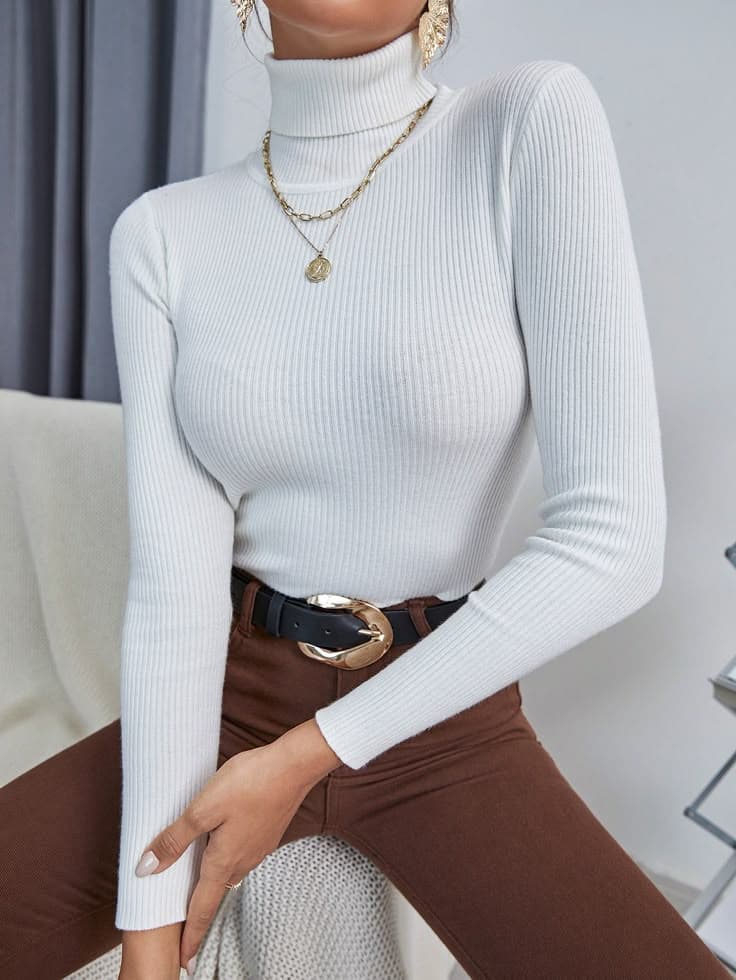
Material changes the message. A thin black turtleneck can look sharp and intellectual, especially under a jacket. A chunky ribbed turtleneck feels protective and wintery. Cashmere softens the severity. Cotton makes it more casual. A tight stretch turtleneck reads close to the body, while a loose rollneck creates volume around the head and shoulders.
The turtleneck's association with seriousness is not accidental. It reduces ornament and color contrast around the chest. It can make the wearer look focused, almost edited. In black, it has become shorthand for design culture and minimal thoughtfulness, sometimes fairly and sometimes lazily. The garment seems to say that decoration has been declined.
At the same time, it can be deeply sensual. Covering the neck does not remove the body; it redirects attention. The line from jaw to shoulder becomes important. The curve of the throat is hidden, so posture matters. A close turtleneck can make the torso more visible because the top half of the body becomes one continuous surface.
Layering is one reason the turtleneck survives. Under a blazer, it replaces the shirt and tie with a smoother column. Under a dress, it makes sleeveless shapes usable in cold weather. Under a coat, it adds warmth without scarf bulk. With jeans, it can look simple and composed. With wide trousers, it lengthens the body. It is one of the easiest garments for making a plain outfit look deliberate.
The turtleneck also carries social contradictions. It can look modest, but also body-conscious. It can feel practical, but also stylized. It can be associated with labor and cold, then with intellectual interiors and galleries. Few garments move so quietly between mountain, studio, office, and dinner.
Fit determines whether it feels comfortable or punishing. A neck that is too tight can feel claustrophobic. A collar that collapses badly can look tired. A fine knit may show every line beneath it. A heavy knit may add too much bulk under outerwear. The garment's simplicity leaves these physical details exposed.
In contemporary wardrobes, the turtleneck is useful because it creates instant continuity. Separates become a single vertical idea. Color blocking looks cleaner. Accessories stand out more clearly. Even a coat can look more expensive when the neckline underneath is controlled.
Its most interesting quality is protection without disappearance. The wearer is covered, but the face becomes more present. The knit holds the body in while presenting the head clearly. That may be why it has been loved by people who want clothes to feel purposeful without speaking loudly.
The turtleneck's political and artistic associations come partly from this refusal of display. It covers the neck, removes the tie, and simplifies the chest. On writers, architects, activists, and performers, it has often read as anti-ornamental seriousness. Whether that seriousness is real or styled, the garment helps create the impression.
Color decides how severe the effect becomes. Black is graphic and almost uniform-like. Cream softens the face. Grey makes the garment more intellectual and casual. Bright colors turn the closed neckline into a bold field. Stripes or ribs add movement to what might otherwise be a solid column.
The turtleneck is also one of the few garments that can replace an accessory. By shaping the neck area, it does some of the work of a scarf, a collar, and sometimes jewelry. That makes it especially useful in cold-weather dressing, where too many layers around the face can become visually noisy.
The turtleneck also has a quiet relationship with jewelry. Large earrings become more visible because the neck is covered. A necklace can either disappear under the knit or sit deliberately over it. Brooches and pins can turn the plain surface into a display. The closed neckline does not end decoration; it relocates it.
As a base layer, it can make unlikely garments wearable. A summer dress becomes winter clothing. A sleeveless top becomes modest. A scratchy jacket gains distance from the skin. Often it is less the star than the piece that allows another garment to remain in rotation.
Its modern appeal also comes from photographic clarity. A dark turtleneck against a plain background makes the face and hands read strongly. This is why portraits, author photos, and design-world imagery have used it repeatedly. The garment removes noise around the face and lets expression, or the refusal of expression, carry the image.
Related articles
March 15, 2026
January 29, 2026
March 26, 2025