Bias Cut and the Moment Fabric Learned to Follow the Body
B
BUYIT Journal· Fashion history notes
The bias cut is not a decoration. It is a decision about direction. Most woven fabric has a lengthwise grain and a crosswise grain, but the bias runs diagonally across them. Cut a garment on that diagonal and the cloth behaves differently. It gains stretch, softness, and a way of falling that can seem almost alive.
That technical fact changed fashion. A dress cut on the straight grain may hang from the body's high points with more predictable structure. A bias-cut dress follows curves without needing darts, boning, or heavy seams in the same way. It can skim the torso, cling at the hip, release at the hem, and shift with walking. The body is not forced into shape; the cloth negotiates with it.
Madeleine Vionnet is one of the designers most closely associated with the mastery of bias cutting in the early twentieth century. Her work showed how mathematical precision and physical fluidity could belong together. Bias cut was not simply "soft." It required deep understanding of fabric, weight, seam placement, and how a garment would behave once gravity met the body.
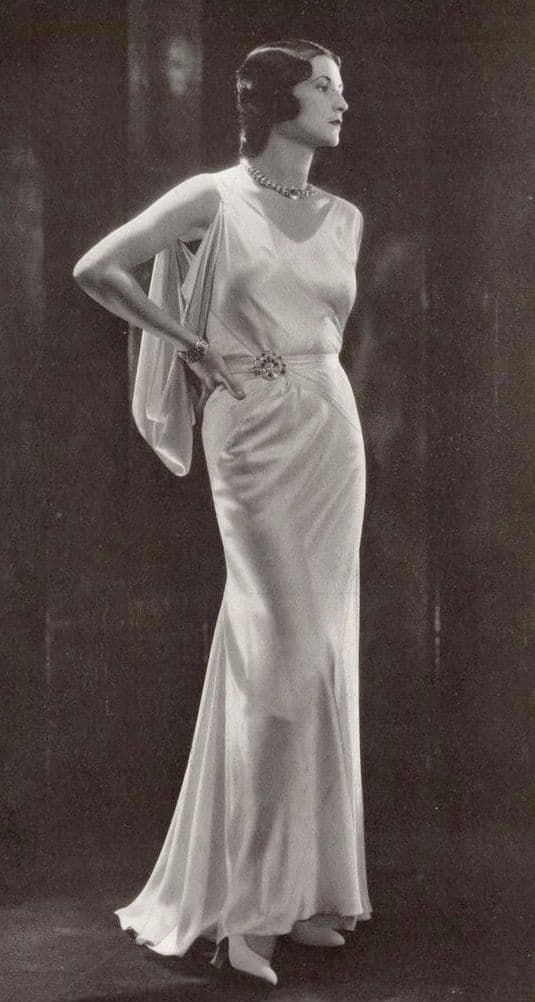
The 1930s made bias-cut eveningwear one of the era's most memorable fashion languages. Long dresses in silk, satin, crepe, and other fluid fabrics could fall close to the body with extraordinary grace. The effect was different from corseted shaping. Instead of building a silhouette through understructure, the garment revealed the body's line through controlled drape.
That control is the key. Bias cut can look effortless, but it is unforgiving. The fabric may stretch while sewing. Seams can twist. Hems can drop unevenly. A poor fabric can cling badly. A well-cut bias dress requires patience because the cloth keeps moving even before the wearer does. The designer must anticipate behavior, not just draw shape.
The sensuality of bias comes from this movement. The garment does not simply expose the body. It responds to it. When the wearer turns, the dress shifts. When she walks, the hem swings with a different rhythm from a straight-cut skirt. Light travels across the fabric in diagonal waves. The body and cloth appear to share the same motion.
This made bias cut especially powerful in cinema. On screen, satin and crepe could catch light and shadow as actresses moved. The dress did not need heavy trimming because movement supplied the drama. A plain bias gown could look more luxurious than an ornamented one if the cloth fell correctly.
Bias cutting also changed ideas of fit. A garment could be close without being rigid. It could reveal without obvious exposure. It could feel intimate because it seemed to listen to the body. That quality made it valuable for eveningwear, lingerie, slip dresses, and later minimalist fashion. The technique carries a quiet charge wherever fabric is allowed to fall diagonally and closely.
There is a reason bias-cut garments often look better in motion than on a hanger. Hung flat, they may seem shapeless. On the body, the diagonal grain activates. The garment needs gravity, warmth, and movement to complete itself. This makes it one of fashion's clearest examples of design that cannot be understood from a static image alone.
Modern slip dresses and satin skirts owe much to this logic. Even when not cut with the sophistication of Vionnet's work, they borrow the idea that fluid fabric can create shape without heavy construction. A bias skirt with a sweater, a bias dress under a coat, a satin slip with boots: all depend on the contrast between soft diagonal fall and the harder lines around it.
The technique also creates vulnerability. Bias garments can reveal underwear lines, body asymmetry, and movement in ways structured garments conceal. They may require careful cutting, lining, or styling. That risk is part of their appeal. The garment is close to the body, but not because it is tight. It is close because the fabric has been persuaded to follow.
Bias cut remains important because it shifted attention from clothing as shell to clothing as relationship. It showed that fabric could create silhouette through direction and gravity rather than force. It made the body visible in a new way: not held, not padded, not compressed, but traced by cloth in motion.
That is why a good bias-cut dress still feels modern. It does not need to announce its technique. It only has to move, and the body understands what the cut has done.
Bias cut also changes the maker's relationship to waste and pattern. Cutting diagonally can require more cloth and more careful layout. The pattern pieces do not behave like simple rectangles placed efficiently on grain. The technique asks for generosity and precision, which is part of why bias garments often feel luxurious even when plain.
Seams become especially important. A side seam on the bias can ripple if mishandled. A center seam can draw the eye down the body. A poorly stabilized neckline can stretch. The beauty of the finished dress depends on invisible technical restraint. The garment looks free because the maker controlled many small risks.
The bias cut also resists the idea that softness is weak. A bias dress can be softer than tailoring but no less exact. Its discipline is hidden in the angle of the cloth. This is why many minimalist garments borrow bias logic: they want the drama of closeness without the visible machinery of construction.
For the wearer, the appeal is sensory as well as visual. Bias-cut fabric can feel cooler, more fluid, more responsive. It moves a fraction of a second after the body, creating a subtle echo. That echo is what gives the technique its emotional charge.
Bias cut has also shaped the way contemporary fashion thinks about restraint. A bias dress can be almost undecorated and still feel designed because the work is inside the fall of the fabric. This kind of quiet construction suits modern taste, where many people want garments that look simple but behave beautifully.
The technique is not limited to gowns. Bias-cut skirts, camisoles, nightgowns, and even certain tops use the same diagonal logic. A satin bias skirt worn with a sweater has become a modern uniform because it combines ease and polish. The top may be ordinary; the skirt supplies movement.
There is also a care issue. Bias garments often need hanging time, careful hemming, and gentle storage. They can stretch unevenly if treated casually. This makes them slightly demanding, but that demand is tied to their beauty. The fabric is alive enough to require attention.
A straight-cut garment can sometimes be judged by measurement alone. Bias cut asks for a fitting in motion. Does the cloth cling or skim? Does the hem swing or collapse? Does the neckline stay calm? These questions make bias one of the most practical tests of whether a garment understands the body.
Bias cut also makes the wearer aware of underlayers. A bulky seam, heavy bra line, or wrong slip can interrupt the whole effect. This does not make the garment impractical; it makes it precise. It asks the layers beneath to be considered as part of the design.
That precision is why bias has such a strong relationship with evening. Evening dress often allows slower movement, controlled lighting, and fabrics that would be demanding in daily life. But when bias elements move into daywear, they bring some of that evening sensitivity with them. A satin bias skirt at noon still carries a trace of night because the fabric remembers glamour even when styled casually.
Related articles
April 28, 2026
November 2, 2025
September 19, 2025
August 5, 2025