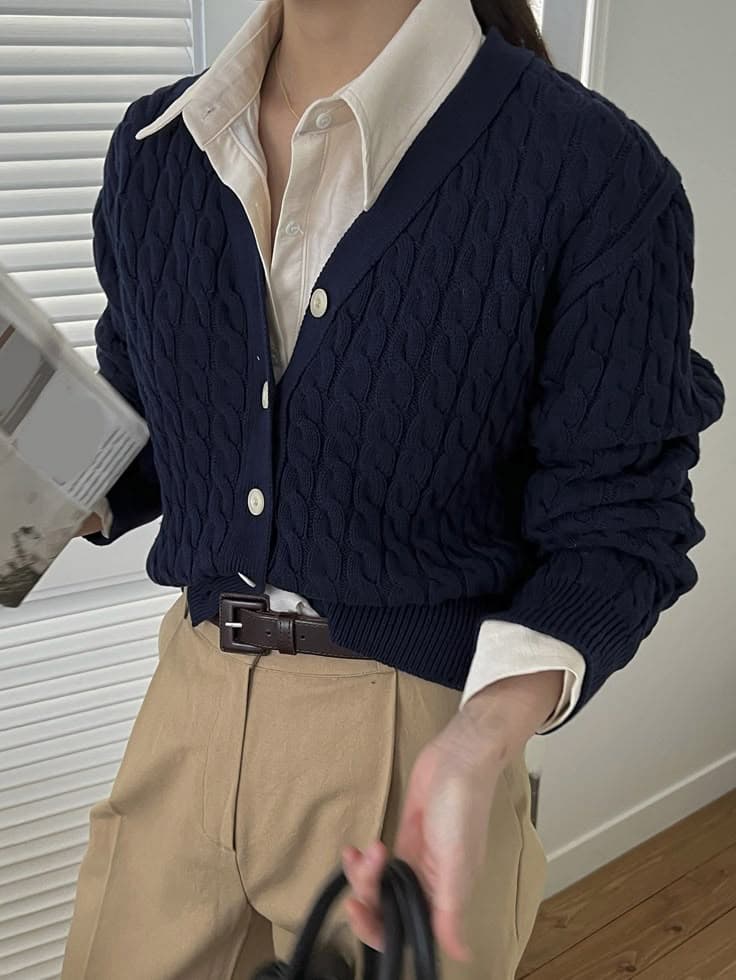
The Cardigan and the Quiet Skill of Layering
B
BUYIT Journal· Fashion history notes
A cardigan is a sweater that opens. That sounds like a small distinction until you watch how people use it. A pullover commits the body to one temperature, one neckline, one block of knit. A cardigan negotiates. It can be buttoned, half-buttoned, left open, shrugged on, tied around shoulders, worn as a top, used as a soft jacket, or kept nearby for the moment a room gets cold.
That adjustability is the cardigan's real design intelligence. It carries warmth without the ceremony of outerwear and structure without the hardness of tailoring. The front opening gives the wearer control. The buttons create rhythm down the torso. The hem can sit at the waist, hip, or thigh, changing proportion. A fine cardigan can be almost invisible under a coat; a chunky one becomes the outer layer itself.
The cardigan's name is commonly linked to the Earl of Cardigan and military knitted jackets, though the garment's long fashion life belongs as much to domestic knitting, sportswear, leisure, and modern layering as to any origin story. By the twentieth century, cardigans had become part of men's and women's wardrobes in many forms: school uniform, golf sweater, twinset, grandparent knit, designer basic, grunge layer, office softener.
The twinset gives one clear example of the cardigan's social work. A matching sweater and cardigan can look coordinated, polite, and controlled. It is softness arranged into order. The same garment, oversized and worn open over a T-shirt, can look casual or intentionally slouched. The cardigan does not have one fixed personality because its meaning depends heavily on proportion and fabric.
Knit structure matters. A fine merino cardigan lies close and behaves almost like a shirt. Cashmere adds luxury through softness rather than shine. Cotton makes the garment cooler and flatter. Ribbing creates vertical texture. Cable knit gives bulk and heritage. Mohair adds fuzz and lightness, blurring the body's edge. Each material changes how the cardigan sits on the shoulder and how much air it holds around the body.
Buttons are more important than they seem. Small tonal buttons disappear. Pearl-like buttons make the cardigan more decorative. Large buttons turn closure into a design feature. Leaving the bottom button open creates movement at the waist. Buttoning only the center can shape the torso. The cardigan lets styling happen at the level of small decisions.
This is why it has often been used to soften stronger garments. Over a slip dress, it makes intimacy less exposed. Over a white shirt, it lowers formality. With jeans, it adds domestic ease. With a skirt, it can look schoolish, romantic, or restrained. A cardigan can make an outfit feel lived in without making it careless.
It also carries age codes in interesting ways. The same garment can look elderly, youthful, intellectual, sexy, conservative, or deliberately awkward. A shrunken cardigan buttoned as a top has little in common with a long grandad cardigan, yet both depend on the open-front knit idea. Fashion keeps returning to the cardigan because it can move between comfort and styling with almost no technical change.
The cardigan is not dramatic by nature, which may be why it lasts. It does not need to dominate an outfit. It improves transitions: indoor to outdoor, summer to autumn, work to evening, bare skin to covered skin. It gives the wearer a way to adjust without disappearing behind a coat.
That modesty is easy to underestimate. A cardigan is often the piece that makes the rest of an outfit wearable. It changes the temperature, the line, and the mood. Its quietness is not lack of design. It is the design of being able to stay, leave, open, close, and adapt.
The cardigan also has a strong relationship with repair and making. Knitwear can be darned, stretched, shrunk, blocked, passed down, or handmade. Even machine-made cardigans carry the memory of loops and rows. That construction gives the garment a softer emotional register than many woven jackets.
Because it opens at the front, the cardigan can show or hide the layer underneath in degrees. A bright T-shirt, a lace camisole, a white shirt, bare skin, or another knit all change the reading. The cardigan is rarely a complete statement by itself. It is a conversation between layers.
The cardigan's emotional range also comes from its closeness to the body. It is often worn in rooms rather than on streets, on chairs rather than in motion, over pajamas as easily as over shirts. This domestic association can make it feel gentle, but designers often use that gentleness against sharper styling. A cardigan worn with leather, a mini skirt, or tailored trousers becomes interesting because it brings indoor softness into public view.
The length of a cardigan controls its mood. A cropped cardigan can act almost like a top, emphasizing the waist and making the buttons central. A hip-length cardigan feels classic and useful. A long cardigan turns into a soft coat, adding vertical movement and sometimes a sense of privacy. Because the basic construction is so familiar, length becomes one of the clearest ways to modernize it.
Cardigans also make color feel approachable. A bright sweater can dominate, but a bright cardigan can be left open, broken by the layer beneath. Neutrals can look quiet without becoming dull because the knit texture carries detail. This is why the cardigan remains useful even in very minimal wardrobes. It adds change without demanding a new silhouette every time.
Related articles
May 20, 2026
April 6, 2026
January 7, 2026
August 27, 2025